Hold Alt, lasso any set of links, and every unique one opens in a background tab. Unlike the right-drag tools, it never touches your browser's right-click menu.
Free. One permission (storage). No account, no servers, no tracking.
The architectural difference
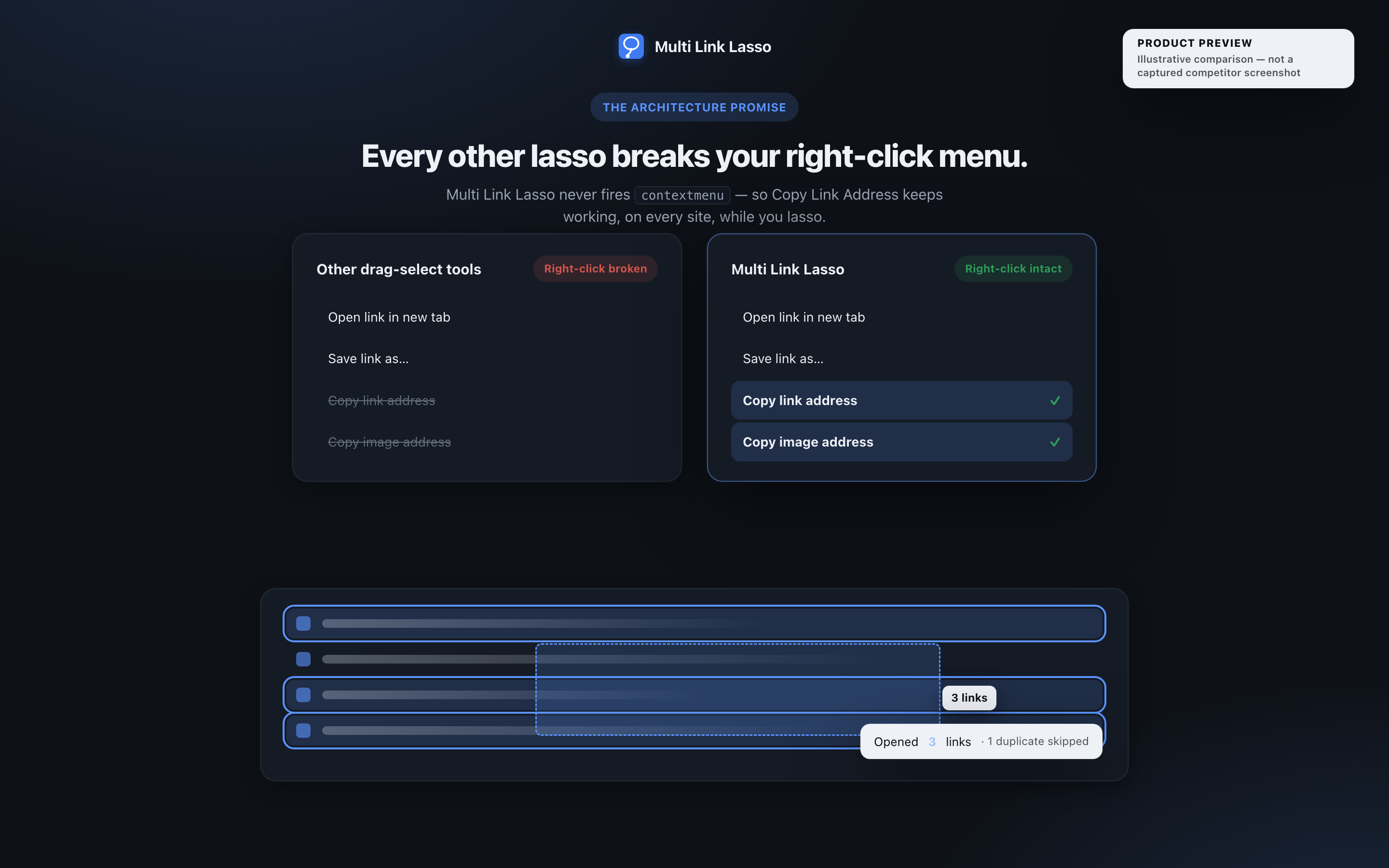
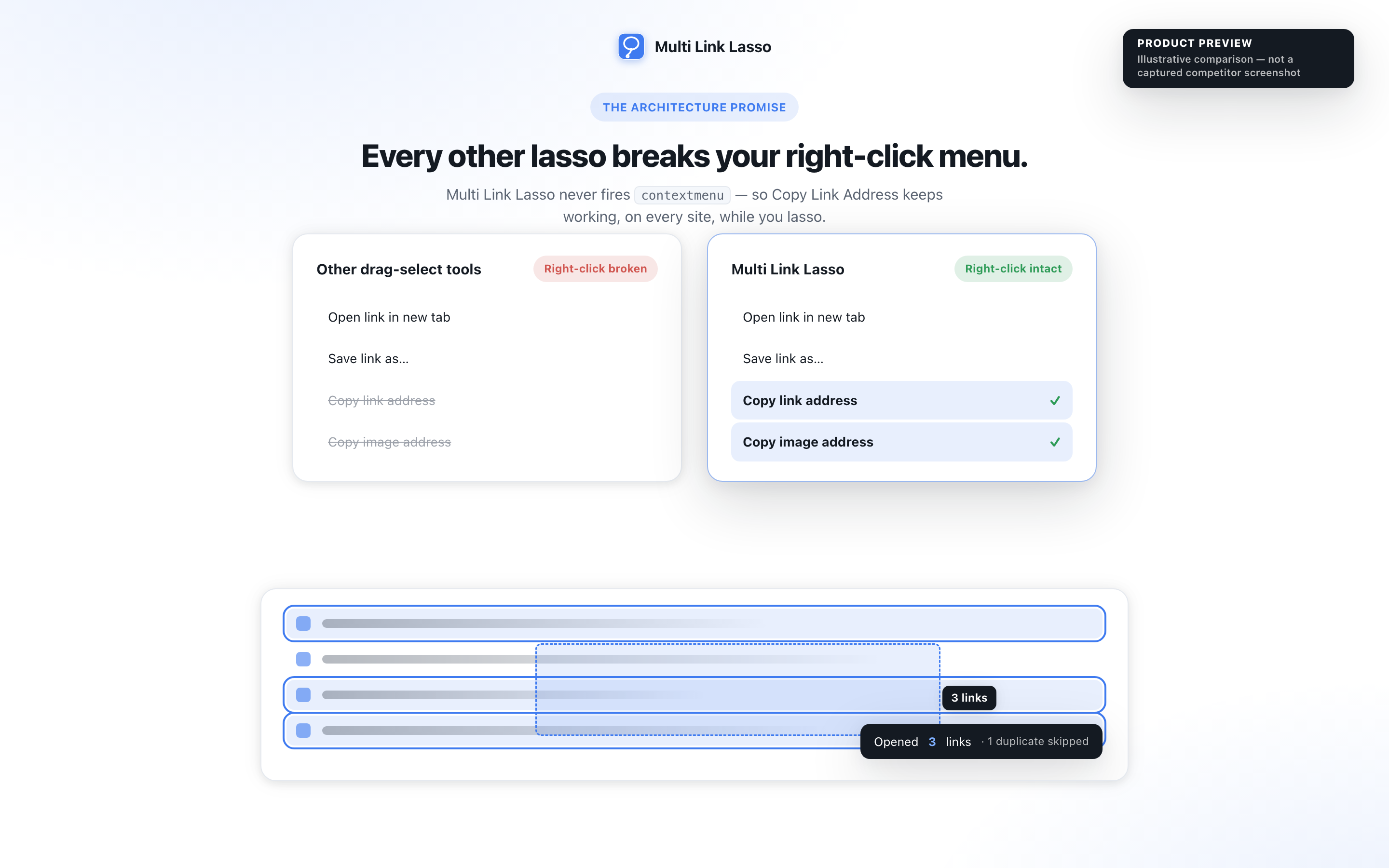
Grabbit and Linkclump power their right-drag trigger by hijacking the browser's contextmenu event, which silently disables "Copy Link Address" and "Copy Image Address" everywhere, including Gmail. Multi Link Lasso's Alt-drag never touches it. The fix is architectural, not a setting.
They cancel contextmenu to detect a right-drag, so the copy items stop working even on a normal right-click.
Alt + left-drag is a separate gesture. Your right-click menu behaves exactly as if nothing were installed.
Illustration of menu behavior for comparison.
Free and Pro features
The category sells a drag gesture. Seven capabilities ship free, forever, in the extension today; four more make up Multi Link Lasso Pro. Every screen below says inside the frame exactly what it is: a real, unmodified capture, or a labeled preview built from the same interface and brand tokens with demo data. Never one presented as the other.
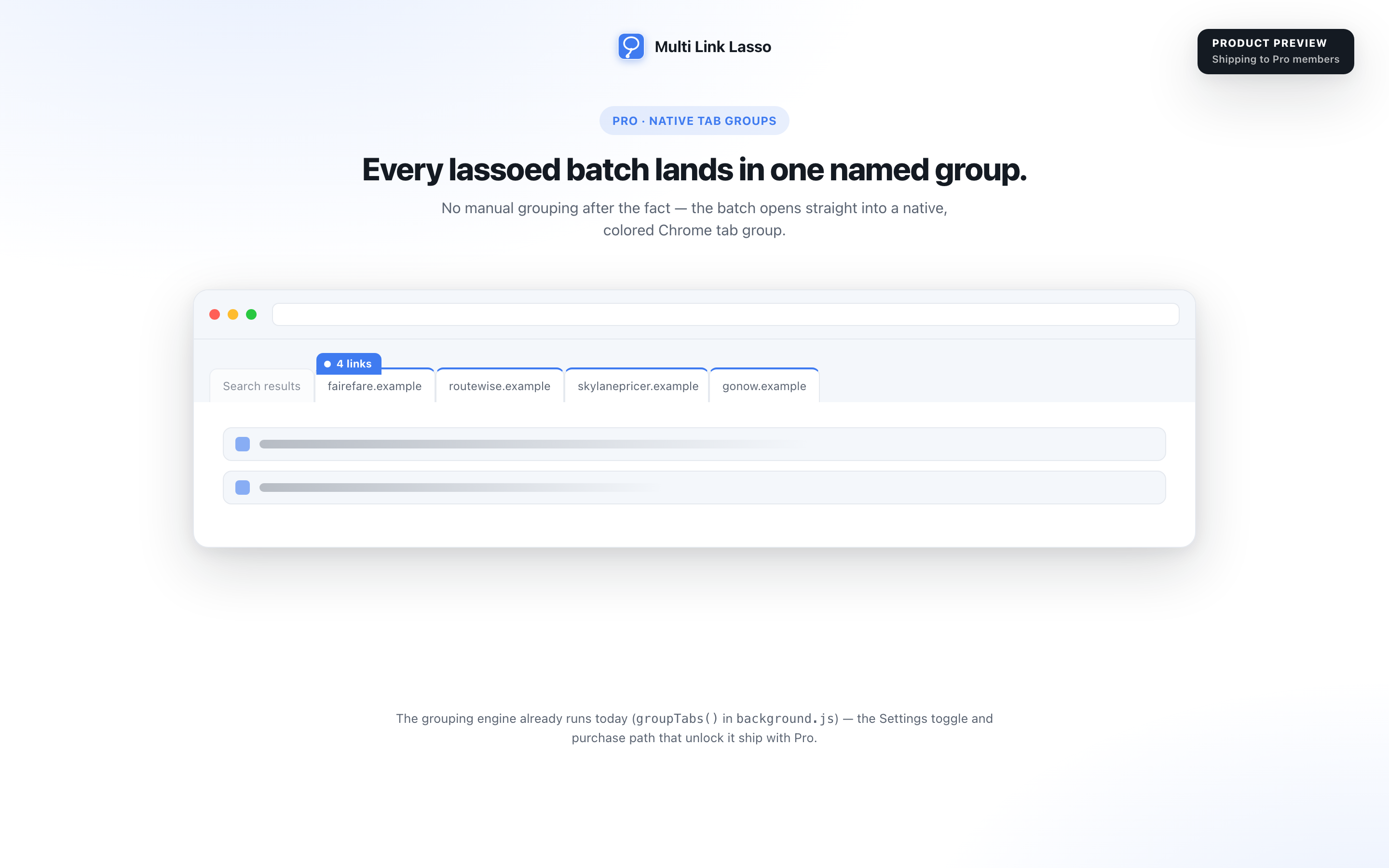
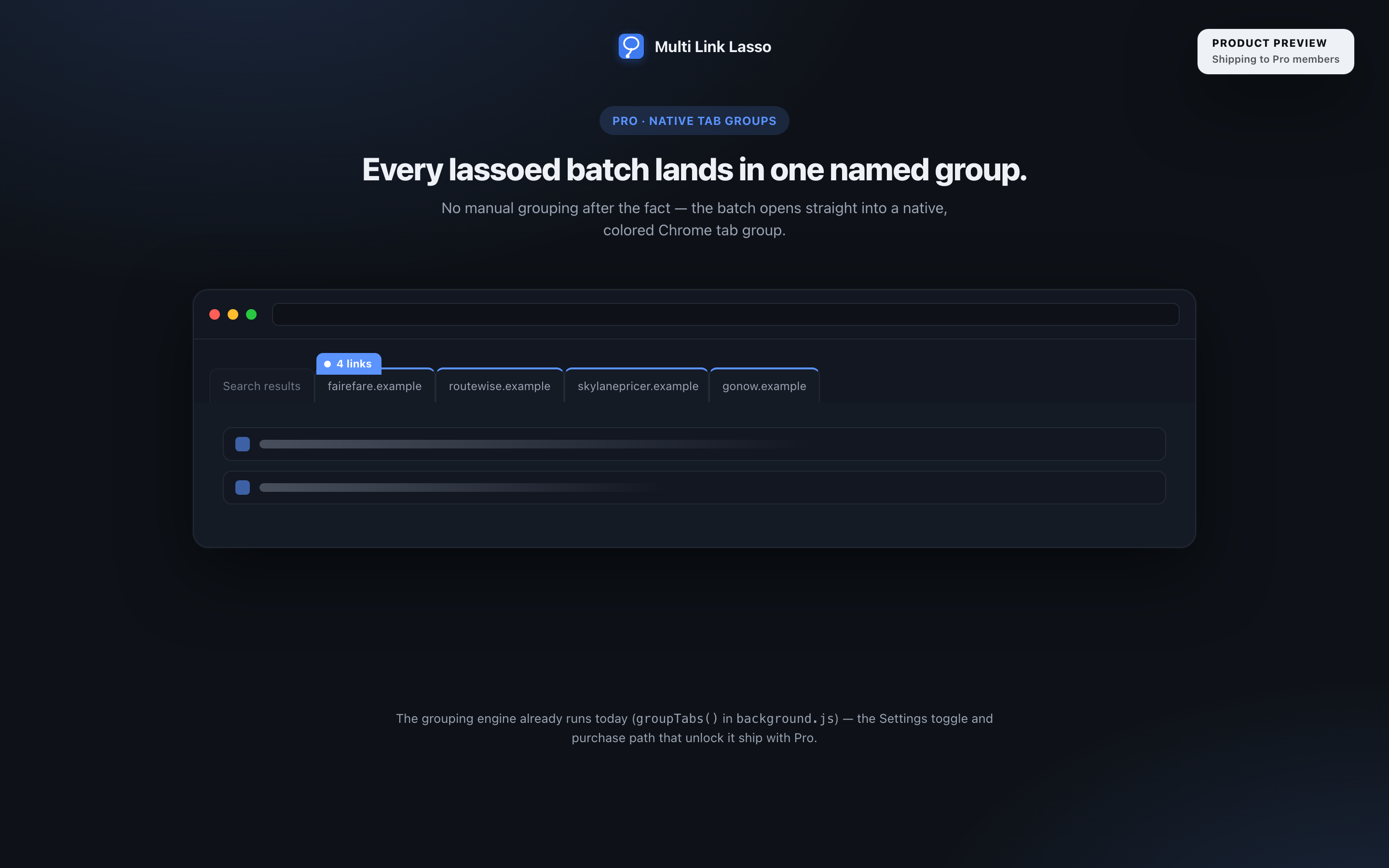
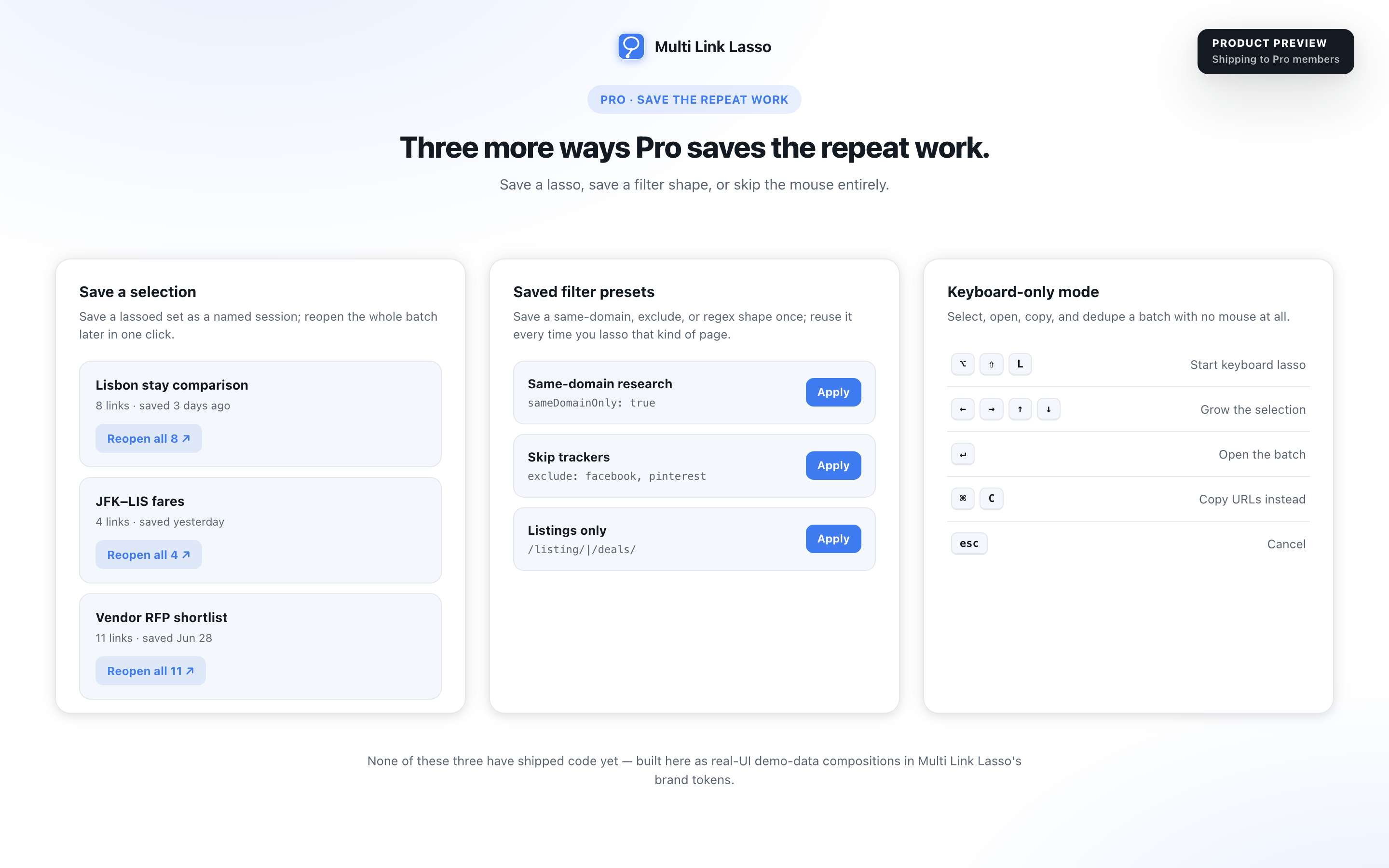
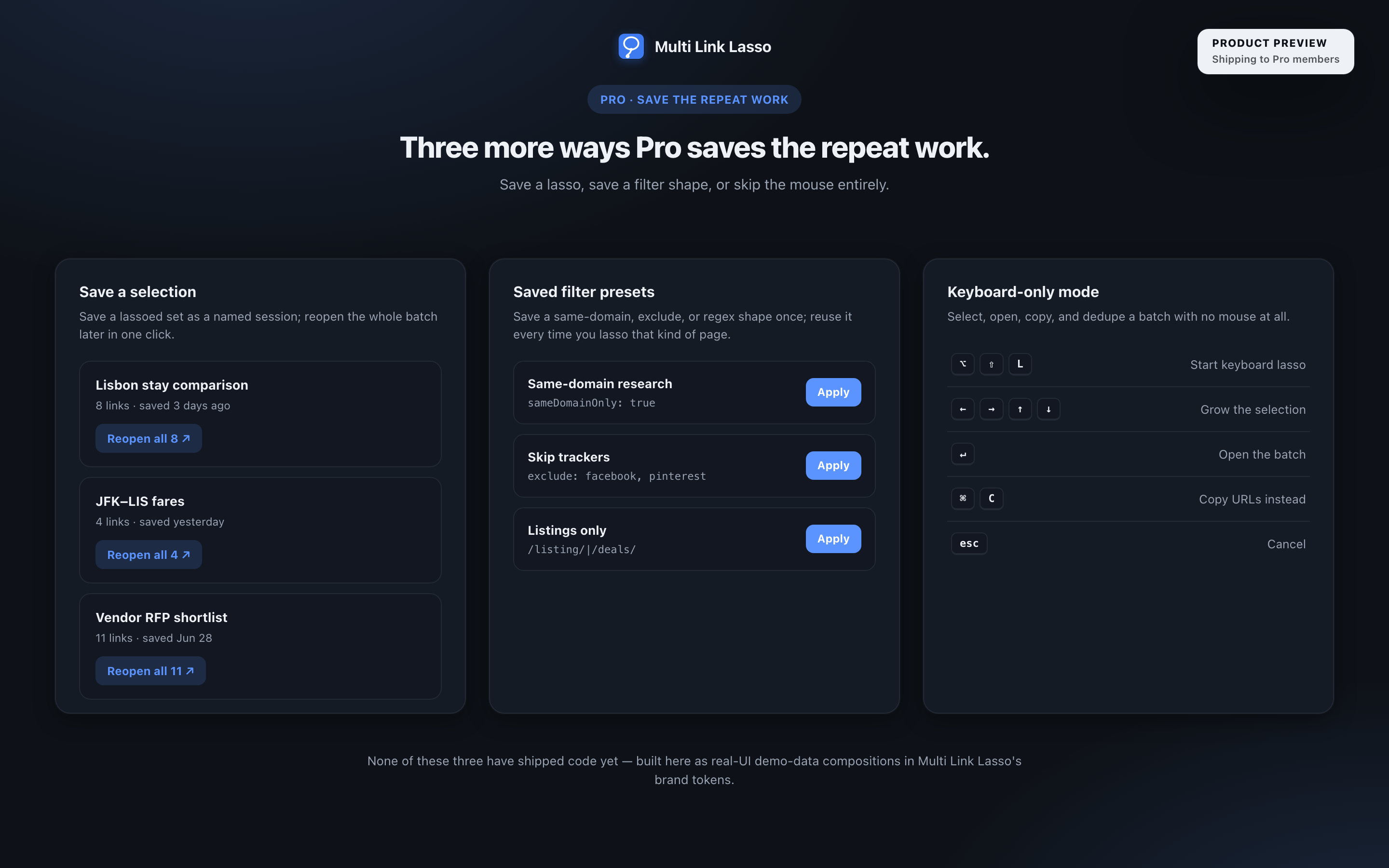
Seven capabilities are shipped in the extension right now, free and forever: the Alt-drag lasso; smart dedupe with redirect/tracking unwrap; precision filters; background opening, position, stagger, and reverse order; the per-site off switch; one-tap undo; and plain-text copy (Markdown and comma-separated values (CSV) formats are still unbuilt). Native tab-group open already runs in the code with no purchase path yet; save-a-selection, saved filter presets, and keyboard-only mode are unbuilt. Pro unlocks all four, once they ship, for one payment.
Pro is a one-time $9.99 purchase, not a subscription.
Three seconds to learn
Press and hold the Option / Alt key (you can change it to Shift or ⌘ in Settings).
Sweep a rectangle over any set of links. A live count shows how many are inside.
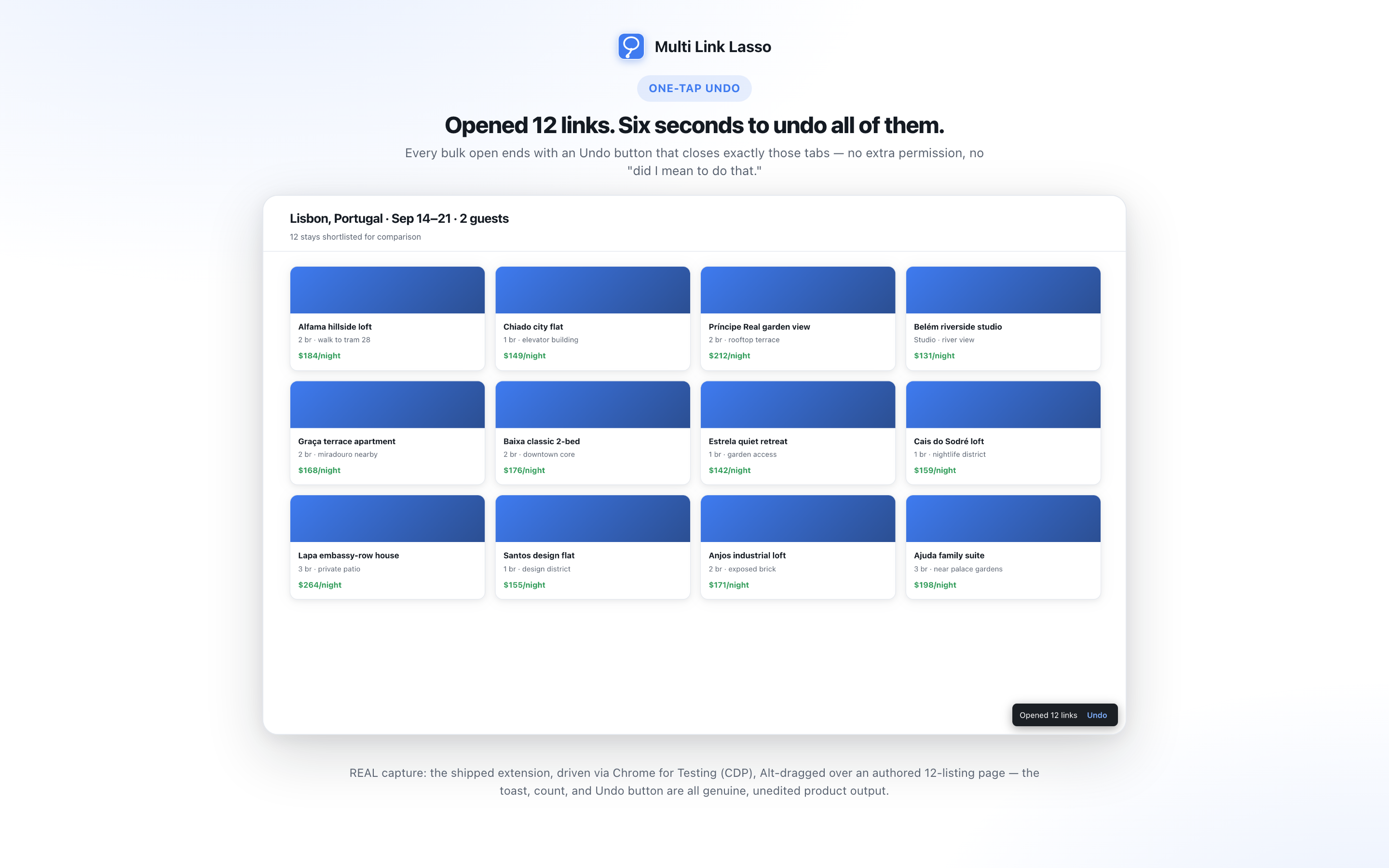
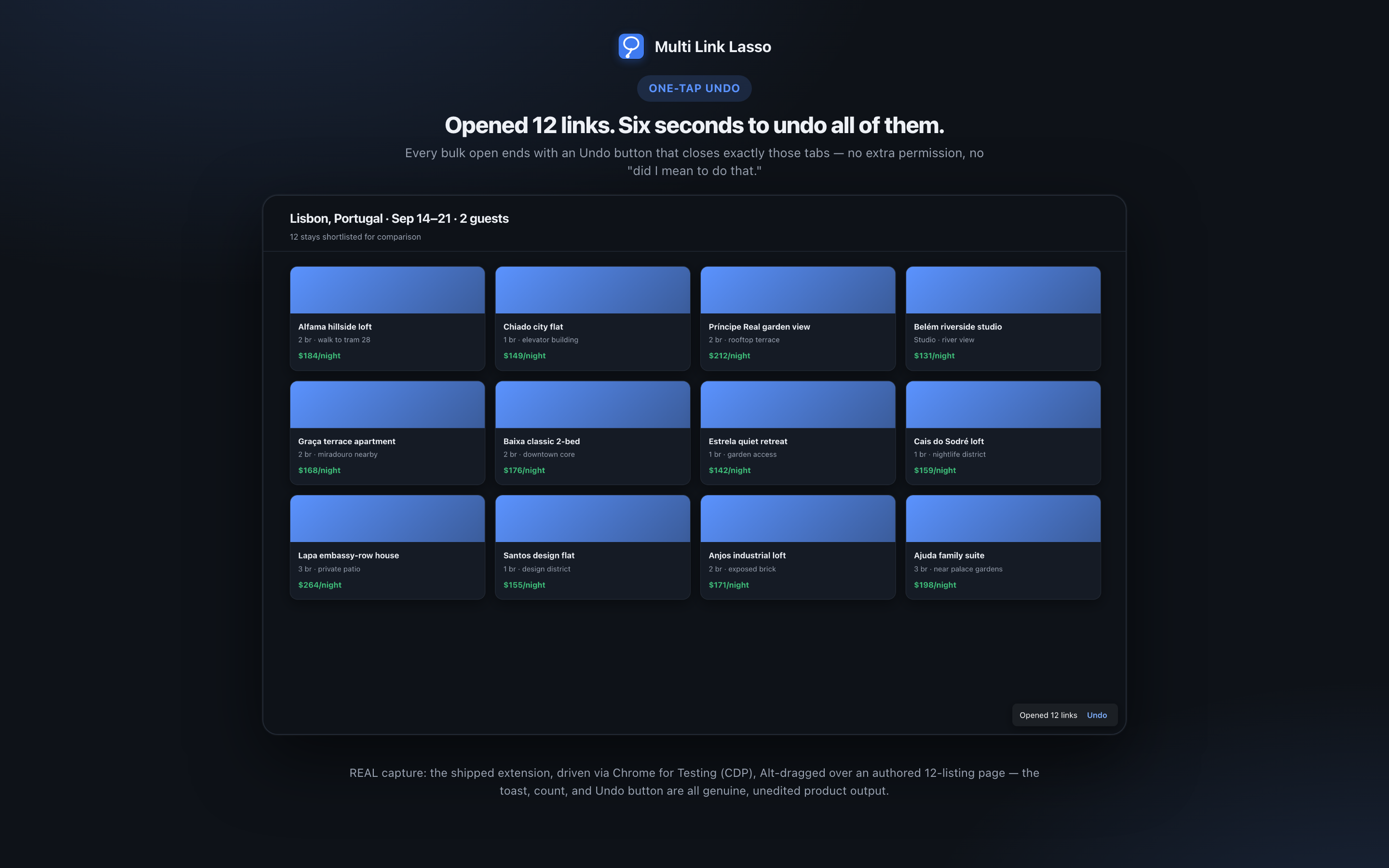
Every unique link opens in a background tab. Changed your mind? One tap closes them all.
Where it earns its keep
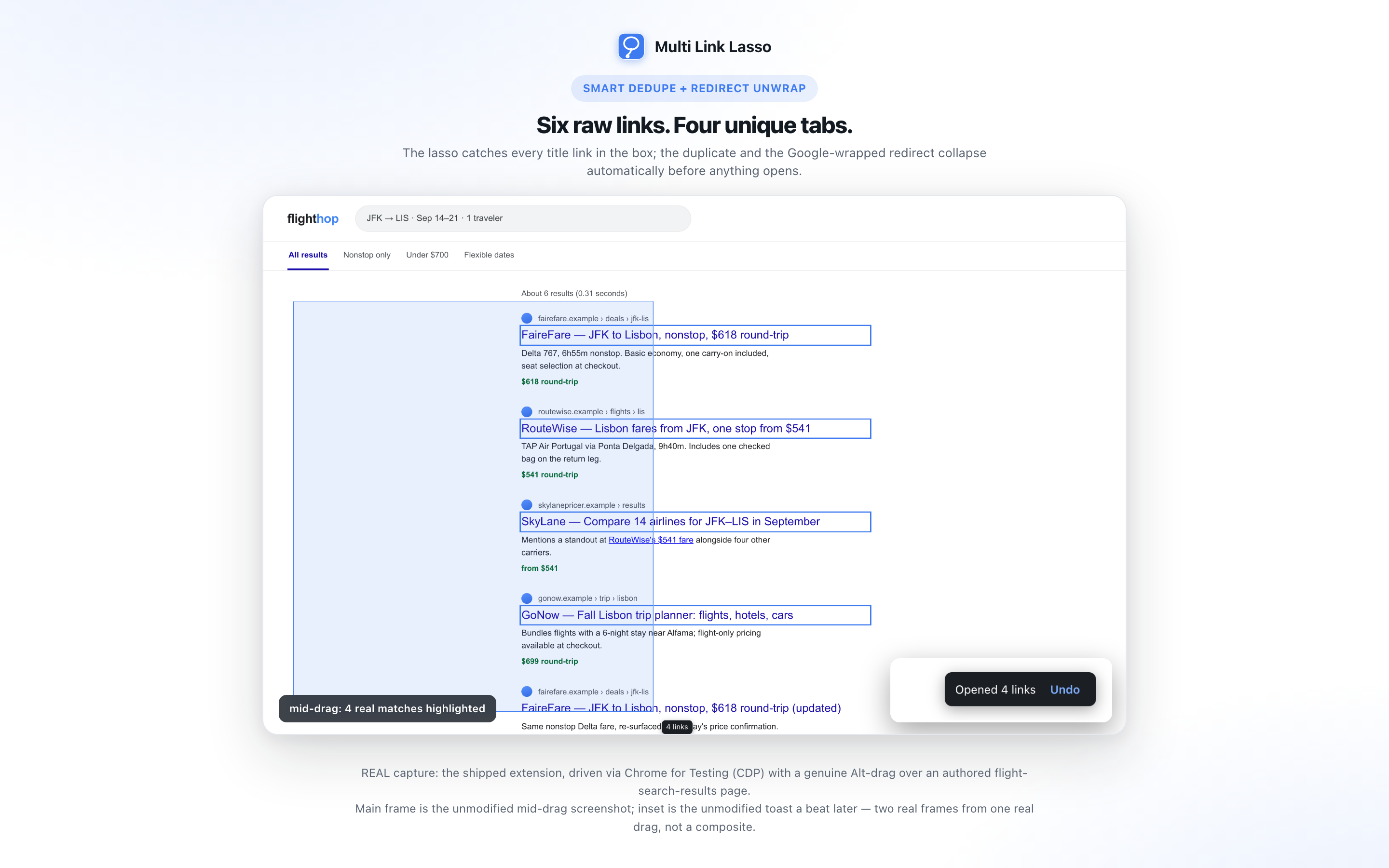
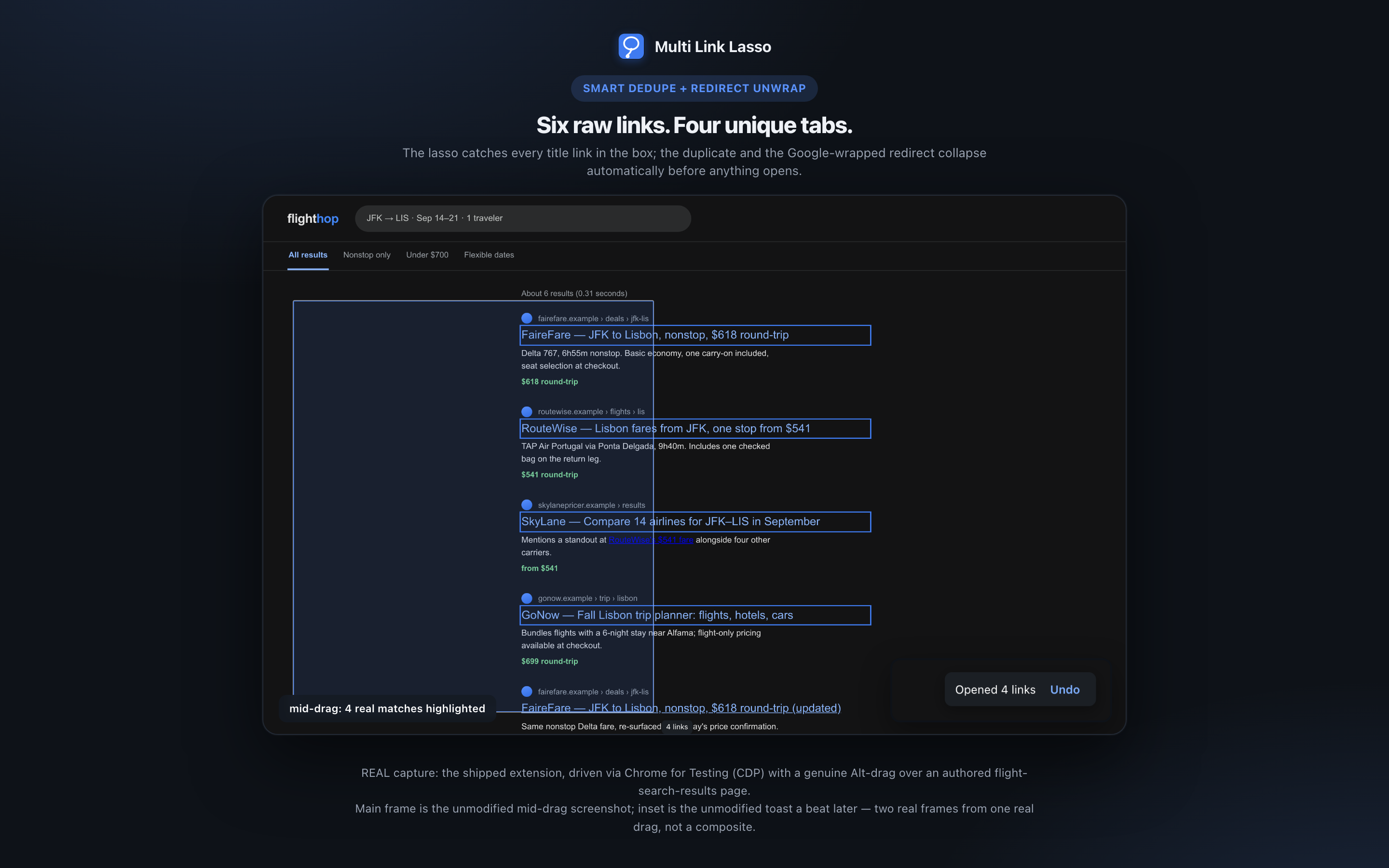
Opening links one at a time costs more than time. Click, wait, come back, find your place, repeat. Hold Alt and drag a rectangle over what you want instead. A live count shows how many links are inside the box. Release, and the extension unwraps redirector URLs, drops the duplicates, and opens what is left in background tabs.
Reading sources one at a time on Google, Bing, or DuckDuckGo breaks the thread of the research. Drag across the whole results page instead. Smart select, on by default, takes the one main link out of each result and skips the thumbnail, the "read more", and the author mention. Redirector links are unwrapped to the real destination across 12 known hosts, including Google, Google News, Bing, DuckDuckGo, Reddit, Facebook, and LinkedIn. Duplicates are matched on scheme, host, path, and query, so the same source caught twice opens once, and your place on the results page never moves.
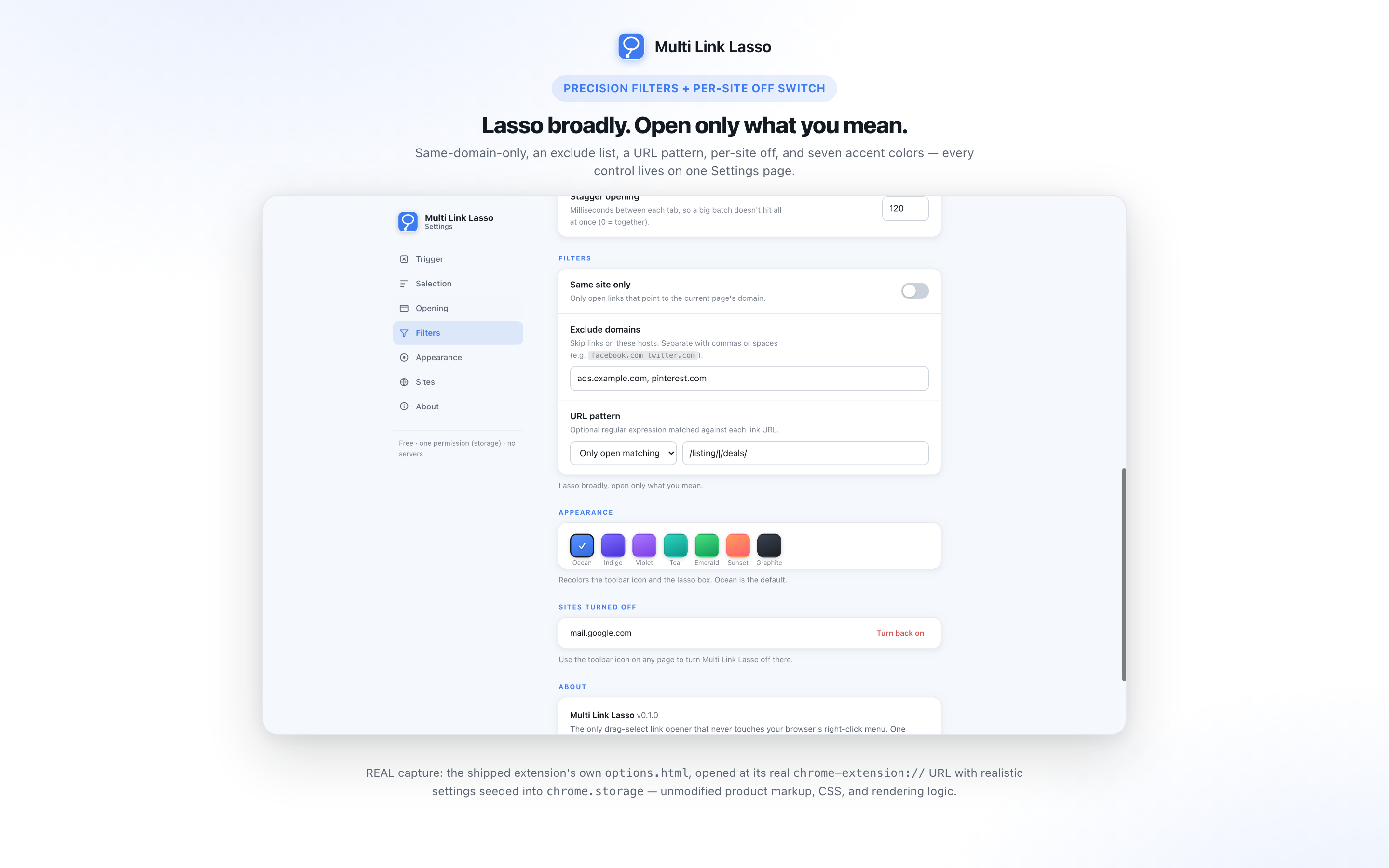
A results grid mixes the listings you want with sponsored placements and links back into the retailer's own promotional pages. Filter the batch before it opens. Same site only keeps every off-domain advertisement out. The exclude list drops named hosts you never want opened. A regular expression, in include or exclude mode, isolates the URL pattern the real listings share, which on most catalogs is the one thing that separates a product page from everything else on the screen. What opens is the set you meant to compare.
Recruiting and sales work starts on a results page full of profiles, and opening 40 of them in the same second is the kind of burst some sites' rate limiting is built to flag. The stagger setting exists for this: set a delay in milliseconds and the batch opens at that pace on its own. On a site that watches for bursts, a slower batch is the safer default rather than a fallback. Minimum links keeps a stray drag from firing at all, and the per-site off switch turns the lasso off entirely on a site where you would rather click.
A dense reference page can carry a "see also" list longer than the section you came for. Sometimes you want all of it open, and sometimes you only want the addresses. Copy mode gives you the second option: release the lasso and the deduplicated, unwrapped URLs go to the clipboard as plain text, one per line, with no tabs opened at all. Paste the list straight into a document, a ticket, or your notes without hand-copying a single address or stripping a single tracking parameter.
A roundup is a long page of links wrapped in text you do not want, which makes it the easiest place to catch more than you meant. Two settings cover it. Minimum links tells the extension to ignore any lasso that catches fewer than the number you set, so a small accidental drag does nothing at all. And when a broad drag does catch the footer, undo is one tap: every batch shows a toast with an Undo button for six seconds, and it closes exactly the tabs that lasso opened. Tabs you already had stay untouched.
Precision
Opening one tab takes no thought. Opening 40 at once is a different problem: one broad drag across a dense page can launch tabs you did not want, hit a site's rate limits, or bury the tab you were reading. These settings are where the precision lives.
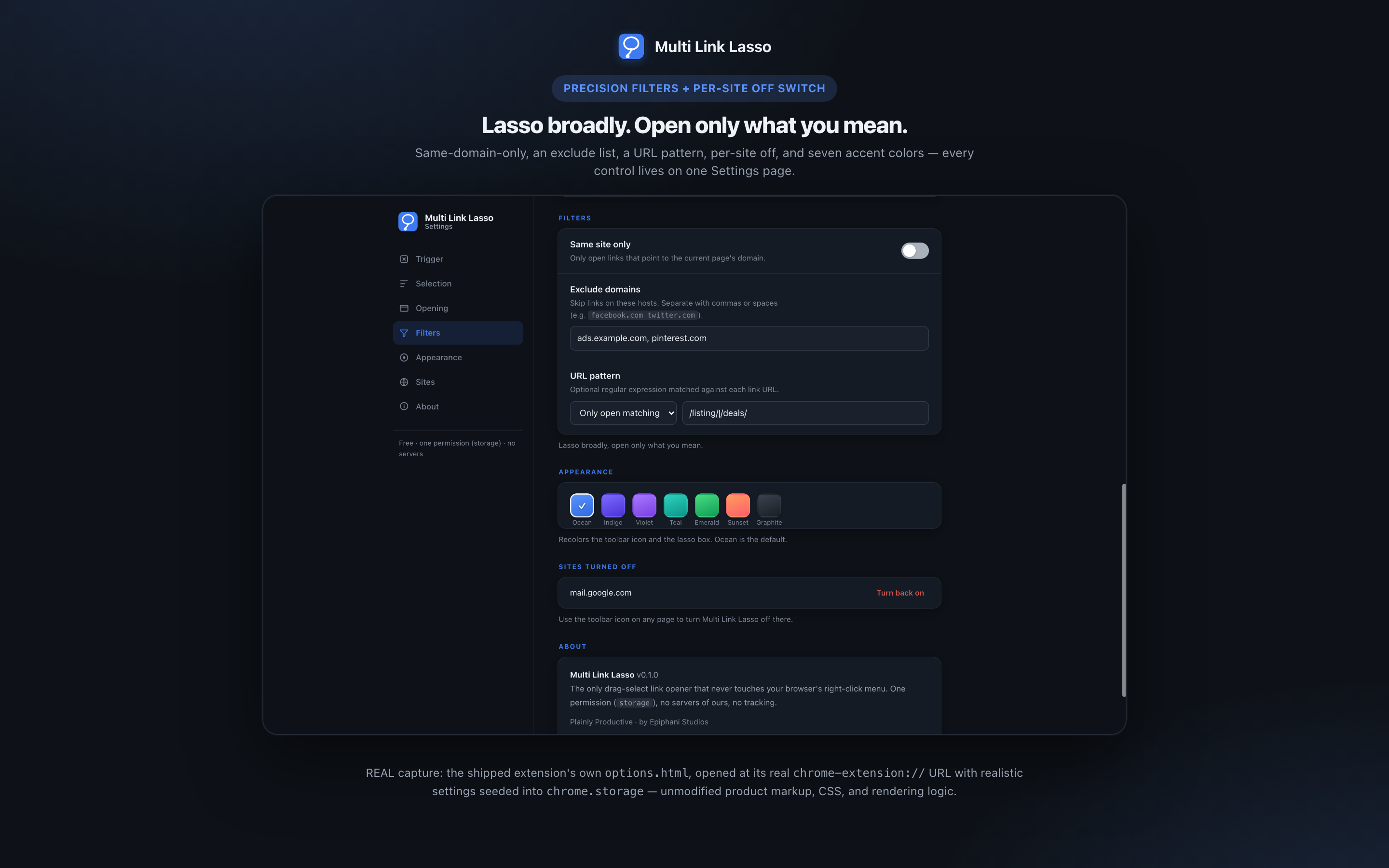
The trigger starts with a modifier key: Alt, Shift, Command, or Control. Alt is the default and the recommendation on a Mac, where Control is already the right-click. Drag with the left mouse button, which is the default and the safe choice, or switch to the right button for the Linkclump-style gesture, where the context menu is canceled only during an actual drag. So a click never turns into a lasso, the box arms only after the pointer has traveled six pixels. Seven accent colors apply to both the selection rectangle and the toolbar icon.
Four settings decide what happens the moment you release. By default links open in the background, so the page you are reading keeps focus. A large batch can go into a new window of its own instead. New tabs appear immediately to the right of the active tab by default, or at the end of the tab strip if you prefer the batch out of the way. Bottom-to-top reverses the order, opening the lowest link on the page first.
Two settings govern how hard a batch lands. Stagger puts a delay in milliseconds between opens, and it defaults to zero, meaning all at once. Minimum links defaults to one, and a lasso that catches fewer links than the number you set does nothing at all. Together they cover both failure modes: the accidental drag that opens something you never meant to open, and the deliberate batch of 40 that arrives fast enough for a site's rate limiting to notice.
Filtering happens before a single tab opens. Smart select, on by default, takes the one main link out of each search result and skips thumbnails, "read more" links, and embedded mentions. Same site only keeps the batch on the current domain. The exclude list skips named hosts. A regular expression runs in include mode or exclude mode. Two behaviors are always on and are not settings: redirector unwrapping, which follows a search engine or social link to its real destination across 12 known hosts, and deduplication, which matches on scheme, host, path, and query so a destination caught twice opens once.
Some sites you would simply rather click on, and that needs neither an uninstall nor a settings trip. One toggle in the toolbar popup turns the lasso off on the site you are on, and every disabled site is listed in Settings so nothing stays off by accident. When you want the addresses rather than the pages, switch the action to copy: the selection goes straight to the clipboard as plain text, one URL per line, and no tabs open at all.
How it compares
The category is older open-source projects, active web store forks, and one paid tool. Linkclump, the original, was archived in December 2024 with a final issue titled "Linkclump shutting down", and its active fork's 2026 reviews report that it no longer works reliably. Grabbit has roughly 100,000 users, charges $3.99 a month for 300 artificial intelligence (AI) requests that summarize or compare pages, and requests seven browser permissions against Multi Link Lasso's one.
| Capability | Multi Link Lasso | Linkclump Plus | Grabbit | Snap Links Plus | RightClickLinkOpener |
|---|---|---|---|---|---|
| Trigger gesture | Alt + left-drag (right-drag optional) | Right-drag | Right-drag | Right-drag | Alt + left-drag |
| Right-click menu keeps working | Yes | No | No | No | Yes |
| Auto-scroll while you drag | No, planned free | Yes | Not verified | Not verified | Not verified |
| One-tap undo of the batch | Yes, six seconds | No | No | No | No |
| Per-site off switch | Yes | No | No | No | No |
| Filters | Same site, exclude list, regular expression | Basic include and exclude | Basic include and exclude | Basic include and exclude | None |
| Leaves your pages unread | Always, by design | Yes | No, reads them for $3.99/mo | Yes | Yes |
| Cap on links per drag | None | None published | None published | None published | 10 |
| Cost | Free; Pro $9.99 once | Free | Free; $3.99/mo for AI | Free | Free |
Two rows go the other way, and they are the two worth knowing about. Linkclump scrolls the page while you drag. Multi Link Lasso does not: there is no scroll code in the content script today, so a single drag reaches only what fits on one screen, which is a real ceiling on a long results page. It is a repeatedly requested feature in the category and it is planned for the free tier, never behind Pro. Grabbit will also summarize and compare the pages it opens, and Multi Link Lasso reads no page content at all. That is the direct consequence of making no network requests: nothing to read the page with, and nowhere to send it.
Competitor details come from a sweep of the Chrome Web Store, Mozilla Add-ons, GitHub, and review aggregators dated 8 July 2026, and from each project's own listing. Install counts and review text move; verify anything decision-grade against the listing itself. Multi Link Lasso is not affiliated with Linkclump, Grabbit, Snap Links Plus, or RightClickLinkOpener.
How it runs
Six things worth knowing before you install it.
A lasso collects the links visible in the window the moment you draw it, so a long page is a handful of quick drags: scroll, drag, scroll again. Drag-to-scroll is next off the bench and lands as a free build.
The collector runs in the page's top frame, which is the list you are looking at and dragging across.
It collects anchors whose address starts with http or https, so a drag over a mixed page picks up the pages you meant and leaves mail links, local file paths and application shortcuts where they are.
Download the package, open the Chrome extensions page with developer mode on, and load it unpacked. Version 0.2.0 is ready to run the moment it loads, with nothing to sign up for.
It runs on the Chromium desktop browsers and uses their own extension interfaces for tabs and local storage, so tab groups and saved lists behave exactly the way the browser already does.
Native tab-group opening runs in the code today. Save-a-selection, saved filter presets and keyboard-only mode are on the bench behind it, and Pro unlocks all four for a single payment.
Answers
No, and that is the whole reason it exists. Linkclump and Grabbit detect a right-drag by canceling the browser's contextmenu event, which disables "Copy link address" and "Copy image address" across every site, Gmail included. Alt plus left-drag is a separate gesture, so contextmenu is never touched. There is an opt-in right-drag mode in Settings for people who prefer the old gesture, and it cancels the menu only during an actual drag.
One: storage, for the seven free capabilities. That is the entire list a plain install ever needs. Opening and closing tabs the extension itself created needs no tabs permission, so even undo adds nothing. Native tab-group opening sits behind the Pro preview: switching it on there asks for tabGroups as an optional permission, and releases it the moment you switch it off, so nothing outside that preview ever touches tabGroups.
No. The extension makes no network requests of its own. There is no server, no account, no analytics, and no tracking. Everything happens inside the browser, which is also why it cannot read or summarize the pages it opens.
Every batch shows a toast with an Undo button for six seconds, and undo closes exactly the tabs that lasso opened and nothing else. Tabs you already had are untouched. Setting a minimum link count also stops a small stray drag from opening anything in the first place.
Yes. Switch the action to copy in Settings. Releasing the lasso then writes the URLs to the clipboard as plain text, one per line, deduplicated and unwrapped to their real destinations, and opens no tabs at all.
Opening a large batch in the same second is the kind of burst some sites' rate limiting is built to catch, and it is a real risk on sites that police it. The stagger setting puts a delay you choose between opens so the batch arrives more gradually, though it reduces the risk rather than eliminating it. On a site you know watches for bursts, use it by default and keep the batches small.
Seven capabilities are free forever: the Alt-drag lasso, smart dedupe with redirect unwrapping, the filters, background opening with position and stagger and reverse order, the per-site off switch, one-tap undo, and plain-text copy. Pro is $9.99 paid once, never a subscription, and it covers native tab groups, save-a-selection, saved filter presets, and keyboard-only mode. Nothing that is free today will ever move behind Pro.
Download the package, open the Chrome extensions page, turn on developer mode, and load it unpacked. It runs on Chrome and on Edge.
Free on Chrome and Edge. Nothing to sign up for.
It installs by loading the package unpacked, and it runs the same on Chrome and on Edge.
Hold Alt, drag a box around any set of links, and every unique one opens in a background tab. Your right-click menu keeps working, which is the part the right-drag tools break.
See how it works